Aerial Work Platforms: Types, UK Regulations, Inspections and Training
Aerial work platforms are machines that lift one or more operators, with their tools, to a working position at height and allow them to work from a guarded platform. In the UK they are usually called MEWPs (Mobile Elevating Work Platforms), the term used in standards and training, while on site you will also hear cherry pickers, boom lifts, scissor lifts or simply powered access. For short and medium-duration work at height, they are now the fastest and safest alternative to ladders and scaffolding.
This guide explains what an aerial work platform is and how it is built, every type on the market and how they are classified under BS EN 280, and a solution many guides overlook: crane baskets, which, with the right equipment, can be certified as a MEWP in their own right. The second part covers UK regulations, LOLER thorough examinations, operator training and the rules for working safely.
Key points
- An aerial work platform (MEWP) lifts people to work at height. It always has a chassis, an extending structure and a work platform.
- The main types are low-level, vertical mast, scissor, articulated boom and telescopic boom, which can be self-propelled, vehicle-mounted, tracked or trailer-mounted.
- BS EN 280 classifies them into groups (A and B) by stability and types (1, 2 and 3) by how they travel.
- A crane basket fitted with an EN 280 kit can be certified as a MEWP and used like any other aerial work platform.
- In the UK, MEWPs need a LOLER thorough examination at least every six months, and operators are usually trained to the IPAF PAL card standard.
Contents
- What is an aerial work platform?
- Types of aerial work platforms
- The work platform: what it must have
- Crane baskets: when they become a MEWP
- Advantages over ladders and scaffolding
- Where aerial work platforms are used
- UK regulations for aerial work platforms
- Maintenance, inspections and thorough examination
- Operator training: the IPAF PAL card
- Ground conditions and outrigger loads
- How to work safely
- How to choose the right aerial work platform
- Standards and sources
What is an aerial work platform?
The reference technical standard, BS EN 280, defines a MEWP as a mobile machine intended to move persons to working positions, where they carry out work from the platform. People may only get on and off the platform at defined access positions, from the ground or the chassis, never at height.
Whatever the model, an aerial work platform always has at least three parts:
- the chassis, the base of the machine: it may be self-propelled, pushed or towed, run on wheels or tracks, or be mounted on a van, truck or trailer. Many machines use outriggers to keep the chassis stable while working;
- the extending structure, which raises the platform: a scissor mechanism, a mast, an articulated boom or a telescopic boom;
- the work platform, also called the basket or cage, with guardrails and on-board controls.
The operator drives the movements from the platform control box. A second set of controls, on the ground or the chassis, is used for emergencies: if the person at height is taken ill or cannot operate the machine, the platform can be lowered from below. Load sensing, tilt sensors and emergency stops complete the safety devices.
Aerial work platforms and other lifting equipment
Several machines look similar but are not aerial work platforms and follow different standards:
- lift tables, used to raise loads in workshops and production lines (BS EN 1570-1);
- platform lifts for people with impaired mobility, installed in homes and public buildings (BS EN 81-41);
- telehandlers, designed to handle materials rather than people;
- mast climbing work platforms (MCWPs), which climb one or two masts tied to a building and are covered by BS EN 1495. They are used as an alternative to scaffolding for long jobs across a whole façade.
This guide deals only with aerial work platforms for lifting people to work at height, in other words MEWPs.
Types of aerial work platforms
Aerial work platforms differ mainly in their lifting structure and in how they move. The two are combined: an articulated boom can be self-propelled, mounted on tracks or fitted to a truck.
By lifting structure
Low-level access and push-around platforms are the smallest machines, with platform heights of a few metres. Some are pushed by hand, others are self-propelled and can be driven at full height. They are designed to replace stepladders in warehouses, shops and fit-out work, and many pass through standard doorways and lifts.
Vertical mast lifts use a telescopic mast to raise the platform straight up. They are compact, have low ground pressure and are used mostly indoors. Some models add a small jib for limited outreach over obstacles, and picking versions carry a tray for stock.
Scissor lifts use a criss-cross structure that extends like a concertina and moves the platform only vertically. In return they offer large platforms and high load capacity, often with a sliding extension deck, so several people can work with materials. Electric slab scissors work on firm, level floors; rough-terrain scissors have larger tyres and outriggers for site work.
Articulated boom lifts, also called knuckle booms, have several hinged sections and often a jib at the end. They move vertically and horizontally and can reach up and over obstacles, such as a canopy, a parapet or pipework. This is the machine most often called a cherry picker.
Telescopic boom lifts, or straight booms, extend in a straight line. They are less flexible than articulated booms but offer the greatest height and outreach, beyond 50 metres on the largest self-propelled models.
By chassis and drive
- Self-propelled: they move under their own power and, on many models, the operator drives directly from the platform.
- Vehicle-mounted (van, truck or 4×4): the boom is fitted to a road vehicle. They drive to site, set up their outriggers and start work, and are the standard choice for street lighting, utilities and highways maintenance.
- Tracked (spider lifts): compact, light machines with outriggers that unfold like spider legs. They work on soft, uneven or sloping ground and fit through narrow accesses, but must be delivered by another vehicle.
- Trailer-mounted: towed behind a van or 4×4 and always used with outriggers deployed.
- Push-around: no drive of their own, moved by hand. This is the case for many low-level and mast machines.
There are also specialist versions, such as insulated platforms for work near live electrical equipment and road-rail platforms for railway maintenance.
The table summarises the main types, with the usual BS EN 280 class of each machine.
| Type | BS EN 280 class | Indicative working height | Indicative platform capacity | Typical use | Good to know |
|---|---|---|---|---|---|
| Low-level / push-around | 1A or 3A | approx. 3–6 m | approx. 100–250 kg | Fit-out, retail, warehouses, light maintenance | Replaces the stepladder; usually one person |
| Vertical mast | 1A or 3A | approx. 4–12 m | approx. 130–200 kg | Indoor maintenance, lighting, building services | Very compact, passes through doorways and narrow aisles |
| Scissor lift | 3A | approx. 6–20 m, more on rough-terrain models | approx. 230–700 kg | Warehouses, industrial buildings, sites with firm ground | Large platform for several people and materials, no side reach |
| Self-propelled articulated boom | 3B | approx. 10–40 m | approx. 200–300 kg | Construction, industrial plants, work around obstacles | Reaches hidden points behind parapets, pipes or machinery |
| Self-propelled telescopic boom | 3B | approx. 15 m to over 50 m | approx. 230–450 kg | Large sites, façades, steel structures | Greatest outreach, but needs room to manoeuvre |
| Vehicle-mounted (van / truck) | 1B | approx. 12 m on vans, over 100 m on the largest truck-mounted models | approx. 200–300 kg | Street lighting, utilities, telecoms, tree work | Travels on the road; the driving licence depends on vehicle weight (category B up to 3,500 kg) |
| Tracked (spider lift) | 1B | approx. 12–50 m | approx. 200–300 kg | Gardens, soft or sloping ground, interiors with narrow access | Light and stable, but must be delivered to site |
| Trailer-mounted | 1B | approx. 10–25 m | approx. 200 kg | Light, frequent maintenance across several locations | Easy to tow, works only on outriggers |
Figures are indicative. Heights refer to working height, that is platform height plus about 2 metres. Capacity and class are also typical values: every model has its own data, shown on the platform plate and in the manufacturer’s specification. The BS EN 280 classes are explained below.
Power source: diesel, electric and hybrid
- Diesel: the most powerful and with the longest duty cycle, suited to outdoor sites and rough terrain. Noise and exhaust fumes rule them out indoors. Many can run on HVO.
- Battery electric: zero emissions at the point of use and quiet, they are the obvious choice indoors, in food and healthcare environments, and for night work in residential areas. Their limit is battery capacity.
- Hybrid or bi-energy: combine an engine and batteries, so the same machine works inside and outside.
Emissions increasingly affect machine choice: in London, for example, construction machinery on many sites must meet the requirements of the Non-Road Mobile Machinery (NRMM) Low Emission Zone. Vehicle-mounted platforms usually drive the boom from the vehicle engine through a power take-off, but many have a battery pack to work with the engine off. Crane baskets, on the other hand, depend on the crane they are fitted to.
BS EN 280 classification: groups and types
Beyond their shape, BS EN 280 classifies MEWPs by stability and by how they travel with the platform raised. These codes appear on specification sheets and organise operator training.
There are two groups. In Group A, the vertical projection of the centre of gravity of the load always stays inside the tipping lines: this covers scissor lifts and vertical mast lifts. In Group B, it can fall outside the tipping lines, as with boom lifts. The group is about stability, not about how many people the platform carries, a point that is often misunderstood.
There are three types. Type 1 machines can only travel in the stowed position. Type 2 machines can travel with the platform raised, but travel is controlled from the chassis. Type 3 machines travel with the platform raised and the operator drives them from the platform. So a self-propelled scissor lift is a 3A and a truck-mounted platform is a 1B.
This combination is the basis of the IPAF training categories (1a, 1b, 3a and 3b), covered later in this guide.
Reading the range diagram
For boom lifts, height alone is not enough. Every model has a range diagram (or working envelope), which shows the combination of height and outreach the platform can reach and, on many machines, how it changes with the load in the basket. Two machines with the same working height can have very different envelopes, so always check the range diagram in the operator’s manual or on the plate in the basket before choosing a machine for a job.
The work platform: what it must have
The platform, or basket, is where the operator and their tools stay for the whole job, and its design directly affects safety and comfort. A well-designed platform has a few essential features:
- guardrails on all sides, with a mid-rail and toe-board, and an entrance gate that closes by itself;
- harness anchor points, sized and marked by the manufacturer;
- a control box with all movements and an emergency stop;
- a plate showing the rated load and maximum number of people;
- a load sensing system, which stops movement if the limit is exceeded.
Two features make a real difference day to day. The first is levelling: as the boom rises and slews, the platform floor must stay horizontal. The second is platform rotation relative to the boom, which lets the operator line up parallel to the façade without repositioning the whole machine. For work near live electrical equipment, the basket material alone is not enough: you need a machine designed and certified for that use.
Crane baskets: when they become a MEWP
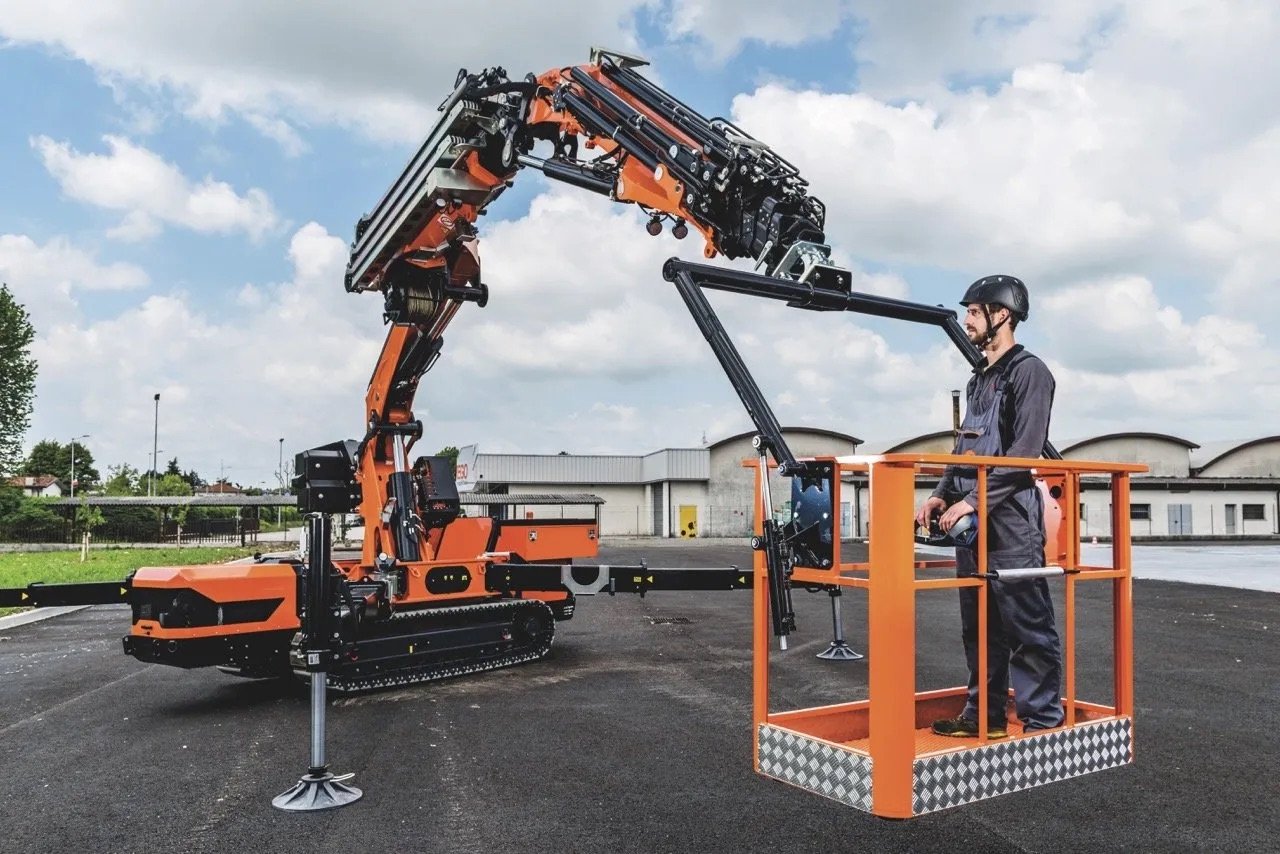
There is one way of getting an aerial work platform that most guides do not mention: the crane personnel basket, also called a man basket. It is fitted to the tip of a crane boom, typically a lorry loader crane, and turns the boom into the means of lifting the operator to height. Its advantage is that it uses a machine that is often already on site or in the company’s fleet.
The critical point is regulatory. A crane is lifting equipment designed for loads, and the LOLER Approved Code of Practice (L113) states that equipment not designed for lifting people should only be used to do so in exceptional circumstances. From here, there are three possible routes.
Exceptional use
Lifting people with equipment not designed for it is accepted only where it is not reasonably practicable to use a safer method, such as a purpose-built MEWP. It requires a specific risk assessment, a lift plan prepared by a competent person, a crane operator who stays at the controls throughout, reliable communication with the people being lifted and a rescue plan. It is not a solution for routine, repetitive or foreseeable work.
Crane + basket with EN 280 kit: a MEWP in its own right
The second route makes the crane basket an aerial work platform for everyday use. If the basket (and, where needed, the crane) is fitted with the safety devices required by BS EN 280, including an angle sensor, dedicated controls, safety valves and load control, the crane + basket combination can be certified as a MEWP. From that point on, it is no longer exceptional use: it is used like any other aerial work platform, with the same training, examination and maintenance obligations.
This is the approach behind Platforms crane personnel baskets. The “Easy” controlled-levelling models, the “SL” active-levelling models and the self-levelling platforms comply with EN 280. Gravity-levelling baskets are built without an angle sensor, mainly for markets where CE marking is not required, but they can be upgraded with Ormet electronic devices for certification as a MEWP.
Advantages over ladders and scaffolding
The Work at Height Regulations 2005 require employers to avoid work at height where they can and, where they cannot, to prevent falls using the right equipment, giving collective protection priority over personal protection. Aerial work platforms fit this hierarchy well:
- fast set-up: no erection or design is needed, as there is for scaffolding, and the machine leaves site as soon as the job is done;
- mobility: the same machine can serve several work points in a single day;
- reach: boom lifts work over obstacles that a ladder or scaffold cannot get past;
- safety: compared with a ladder, the operator works from a guarded platform with both hands free and tools and materials on board;
- less disruption: no need to close off an area for days, as a scaffold would.
Scaffolding, or a mast climbing platform, remains the better option for long jobs covering a whole façade or needing many people at once.
Where aerial work platforms are used
- construction and refurbishment: façades, roofs, cladding and windows, where a MEWP or a basket on the crane already on site saves days of scaffolding;
- street lighting and highways: lamp columns, traffic signals and signage, with machines that set up and move quickly;
- utilities and telecoms: overhead lines, masts, solar and HVAC installations, with insulated machines and specific procedures near live equipment;
- industry and logistics: factories, overhead cranes, racking and building services, with electric machines indoors and crane baskets outside;
- arboriculture: mainly spider lifts and vehicle-mounted articulated booms;
- facilities management: cleaning glazing and façades and routine building maintenance;
- events and signage: lighting rigs, stages, signs and billboards, with compact machines and tight schedules;
- rail, ports and infrastructure: bridges, tunnels, overhead line equipment and port cranes.
To see where a basket fitted to the crane is the most effective solution, read the 7 sectors where crane baskets are essential.
UK regulations for aerial work platforms
The rules fall into two groups: those aimed at whoever manufactures and supplies the machine and those aimed at whoever uses it.
For manufacturers and suppliers: BS EN 280 and UKCA/CE marking
In Great Britain, MEWPs are machinery under the Supply of Machinery (Safety) Regulations 2008, which list them among the higher-risk machines requiring additional conformity assessment. They must carry the UKCA marking or, since the Government extended its recognition indefinitely, the CE marking. The harmonised design standard was for many years EN 280:2013+A1:2015, withdrawn in 2025 and replaced by EN 280-1:2022 and EN 280-2:2022, published in the UK as BS EN 280-1 and BS EN 280-2.
Across the EU, the new Machinery Regulation (EU) 2023/1230 applies from 20 January 2027, and it will also apply in Northern Ireland. For Great Britain, the Government has brought forward legislation to continue recognising CE-marked machinery that meets the new EU requirements.
For employers and users: HSWA, WAHR, PUWER and LOLER
- The Health and Safety at Work etc. Act 1974 sets the general duty to protect workers and anyone affected by the work.
- The Work at Height Regulations 2005 require work at height to be properly planned, supervised and carried out by competent people, using the most suitable equipment.
- The Provision and Use of Work Equipment Regulations 1998 (PUWER) require equipment to be suitable, maintained in a safe condition and used only by people with adequate information, instruction and training.
- The Lifting Operations and Lifting Equipment Regulations 1998 (LOLER) apply because MEWPs lift people: every lifting operation must be planned, supervised and carried out safely, and the machine must undergo regular thorough examinations.
For a wider view of employer duties for work at height, read Working at height: definition, regulations and training.
Maintenance, inspections and thorough examination
UK law sets three levels of checks for aerial work platforms:
- pre-use checks, carried out by the operator before every shift: controls, emergency stops and lowering, guardrails, tyres or tracks, leaks and legible plates;
- maintenance and inspections under PUWER, following the manufacturer’s schedule and the conditions of use;
- a LOLER thorough examination by a competent person at least every six months, because MEWPs lift people, or in line with an examination scheme drawn up by a competent person. A thorough examination is also required after any event that could affect safety, such as an accident or major repair.
The competent person issues a written report, and any defect that puts people at risk must be reported and corrected before the machine is used again. Reports must be kept and made available, and hire companies must supply evidence of the latest thorough examination with the machine.
Operator training: the IPAF PAL card
UK law does not prescribe a specific licence for operating a MEWP. What it does require, under PUWER and the Work at Height Regulations, is that operators are trained and competent for the equipment they use. In practice, the most widely recognised proof of training is the IPAF PAL card (Powered Access Licence), which most principal contractors and hire companies ask for.
IPAF training is organised into categories that combine the BS EN 280 type and group:
- 1a (static vertical): vertical machines that travel only in the stowed position, such as push-around mast lifts;
- 1b (static boom): boom machines that travel only in the stowed position, such as vehicle-mounted and trailer-mounted platforms and many spider lifts;
- 3a (mobile vertical): vertical machines driven from the platform, such as self-propelled scissor lifts;
- 3b (mobile boom): boom machines driven from the platform, such as self-propelled articulated and telescopic booms.
There are also categories for push-around verticals and other specialist machines, and an advanced PAL+ module for boom operators. Courses combine theory and a practical test, and the PAL card is valid for five years. Training does not replace familiarisation on the specific model, which the employer or hire company must provide, or training in the use of fall protection equipment. Managers and supervisors of MEWP work can also follow dedicated courses, such as MEWPs for Managers.
Ground conditions and outrigger loads
The stability of an aerial work platform starts where the machine meets the ground. A MEWP concentrates its weight onto a few small contact points: according to IPAF, a car tyre exerts about 2.4 bar on the ground, while a MEWP outrigger without a spreader plate can exceed 13.8 bar. Ground that easily carries a van can therefore give way under an outrigger.
The ground deserves particular attention on made ground and brownfield sites, over recently backfilled trenches, manholes and underground services, on block paving and on indoor floors and mezzanines, whose load capacity must be checked. Rain can soften the ground from one day to the next, so conditions should be checked again whenever they change.
UK industry guidance, such as the Ground Conditions for Construction Plant guide by the CPA and the Strategic Forum Plant Safety Group, shares responsibilities clearly: the principal contractor ensures the ground is suitable and provides information on bearing capacity and underground services; the contractor using the MEWP selects the machine and plans the set-up; the operator checks the ground on the day and reports any change.
Spreader plates spread the outrigger load over a larger area, and IPAF recommends using them whatever the apparent ground conditions. Their size depends on the maximum outrigger load, given in the operator’s manual, and on the bearing capacity of the ground: IPAF offers a free spreader pad calculator for this. The same applies to crane baskets, whose stability depends on the crane’s outriggers and the ground beneath them.
How to work safely
Aerial work platforms are very safe when used as the manufacturer intends. The main risks are falls from the platform, even without overturning, because of the catapult effect; overturning on sloping or weak ground, with poorly set outriggers or an overloaded platform; trapping and crushing against overhead structures; contact with overhead power lines; and falling objects striking people below. Almost all of them are prevented by a few rules.
Before going up
- carry out the pre-use checks and make sure the latest thorough examination report is valid;
- check the ground as described above, level the machine and always use outriggers where fitted, with suitable spreader plates;
- cordon off the work area and check for overhead lines (see HSE guidance GS6), obstacles, traffic and wind speed, which must stay within the manufacturer’s limit.
While working
- on boom lifts (1b and 3b), wear a full body harness with a short, adjustable work restraint lanyard attached to the platform anchor point, so you cannot be thrown out of the basket. On scissor and mast lifts (1a and 3a), a harness is generally not needed unless the risk assessment or the manufacturer requires it;
- respect the rated load and number of people on the plate and never override safety devices;
- never climb on the guardrails or use ladders inside the platform, and do not use the platform to lift materials or to step onto other structures unless the manufacturer allows it;
- where there is a risk of trapping against overhead structures, use machines with secondary guarding and plan the movements carefully.
After work and in an emergency
At the end of the job, lower the platform, park the machine on firm ground, remove the key and report any defect. Throughout the work, there must be someone on the ground trained in the emergency controls, able to bring the platform down if the operator cannot. The rescue plan is drawn up before work starts, not during it.
How to choose the right aerial work platform
- What height and outreach do you need? A vertical machine if the work point is directly above, a boom if you need to work over obstacles or away from the base. Check the range diagram, not just the maximum height.
- Where will you be working? Indoors or outdoors, firm or soft ground, tight access, public roads. This also decides the power source.
- How many people and how much material? Choose capacity and platform size for the actual job, not the average one.
- How often? A one-off task and continuous work call for different solutions.
- Is a crane already available? If you already have a lorry loader crane, a crane basket with an EN 280 kit can save bringing a second machine to site.
Aerial work platforms cover a very wide range of machines, from the small push-around lift to telescopic booms over 50 metres. Among them is also the crane fitted with a basket certified as a MEWP, a solution that makes the most of equipment you already have, provided the design and safety devices meet the standard. To find out which configuration suits your crane, explore the Platforms range of crane baskets and platforms.